Citizen Science: Make a Nature Observation Useful Before Pressing Submit
Key Points:
- Choose a project and read its current protocol before collecting observations.
- Record effort, circumstances and identification uncertainty so the information can be interpreted.
- A personal notebook does not automatically meet a research project's data requirements.
- Protect private or sensitive locations and avoid disturbing organisms to complete a record.
A nature observation becomes more useful when someone else can understand what was observed, where, when and under what conditions. A striking photograph can help, but it does not replace a clear record. Participatory science projects turn many observations into information that researchers can investigate. The quality of an individual contribution depends less on sounding certain than on following the project’s method and preserving the difference between what you saw and what you inferred.
Choose a project before inventing a method
The Cornell Lab of Ornithology's Center for Engagement in Science and Nature describes participatory science as a way for people to share data that can contribute to scientific understanding. Projects differ in their goals and recording requirements. An incidental sighting, a timed count and a structured survey are not automatically interchangeable. Start by reading the selected project’s current instructions, eligibility and safety guidance rather than assuming one generic observation format will suit every research question.
Our suggestions in this article are an original planning framework, not a substitute for a project’s protocol. If a project specifies a count duration, area or method, follow that requirement. Do not change the method halfway through and submit the result as if nothing changed. If you cannot meet the protocol, check whether the project accepts a different type of observation. An honest limited contribution is more useful than a detailed-looking record whose method is unclear.
| Record field | Example of useful detail | Why it helps |
|---|---|---|
| Time | Date, start time and duration where required | Distinguishes a brief sighting from a longer search |
| Place | Approved location detail and habitat description | Connects the observation to its setting |
| Effort | Area covered and method used where requested | Helps interpret differences between visits |
| Identification | Observed features and confidence | Keeps a tentative identification from appearing certain |
| Evidence | Permitted photograph or note | Allows review without inventing missing details |
Observe first and name second
When an organism is unfamiliar, record visible features before deciding on a species name. Shape, color, behavior and setting may help a project reviewer interpret the observation. Do not fill missing details from an identification app’s suggestion. An app can offer a candidate, but the observation should still describe what you actually saw. If the project permits uncertain identifications, use that option rather than converting a guess into a confident label to make the record look complete.
For an original example, imagine seeing a small bird briefly in poor light. You might note its approximate size relative to a familiar object, a visible marking and the behavior you observed. If you did not see the bill clearly, do not add a bill description because a suggested species usually has one. The point is not to produce an impressive field narrative. It is to preserve evidence that can be checked without mixing observation and expectation.
Effort changes what a count means
Seeing five individuals during a two-minute stop and five during an hour-long search are different observations. The count is the same, but the opportunity to detect organisms differs. Whether and how effort should be recorded depends on the project. Read its instructions carefully. A useful contribution may require time, distance, number of observers or a defined area. Do not assume that a larger count necessarily means a more abundant population when observation effort has changed.
A simple personal practice is to keep the method similar on repeat visits and note unavoidable differences. Perhaps one visit used a different path or was interrupted. Record the change rather than quietly treating the visits as equivalent. These notes do not turn a casual project into a formal ecological study, but they make your own comparisons more honest. If the project has a specific rule for incomplete surveys, use that rule instead of improvising an unmarked correction.
A photograph is evidence with limits
A photograph can preserve visible features, but it may omit scale, behavior, location context or parts needed for identification. A sharp image does not guarantee a correct species label. Include the information the project requests, and avoid editing a photograph in ways that change the features being evaluated. If ordinary cropping or exposure adjustments are permitted, follow the project’s guidance and retain the original for your own records where appropriate.
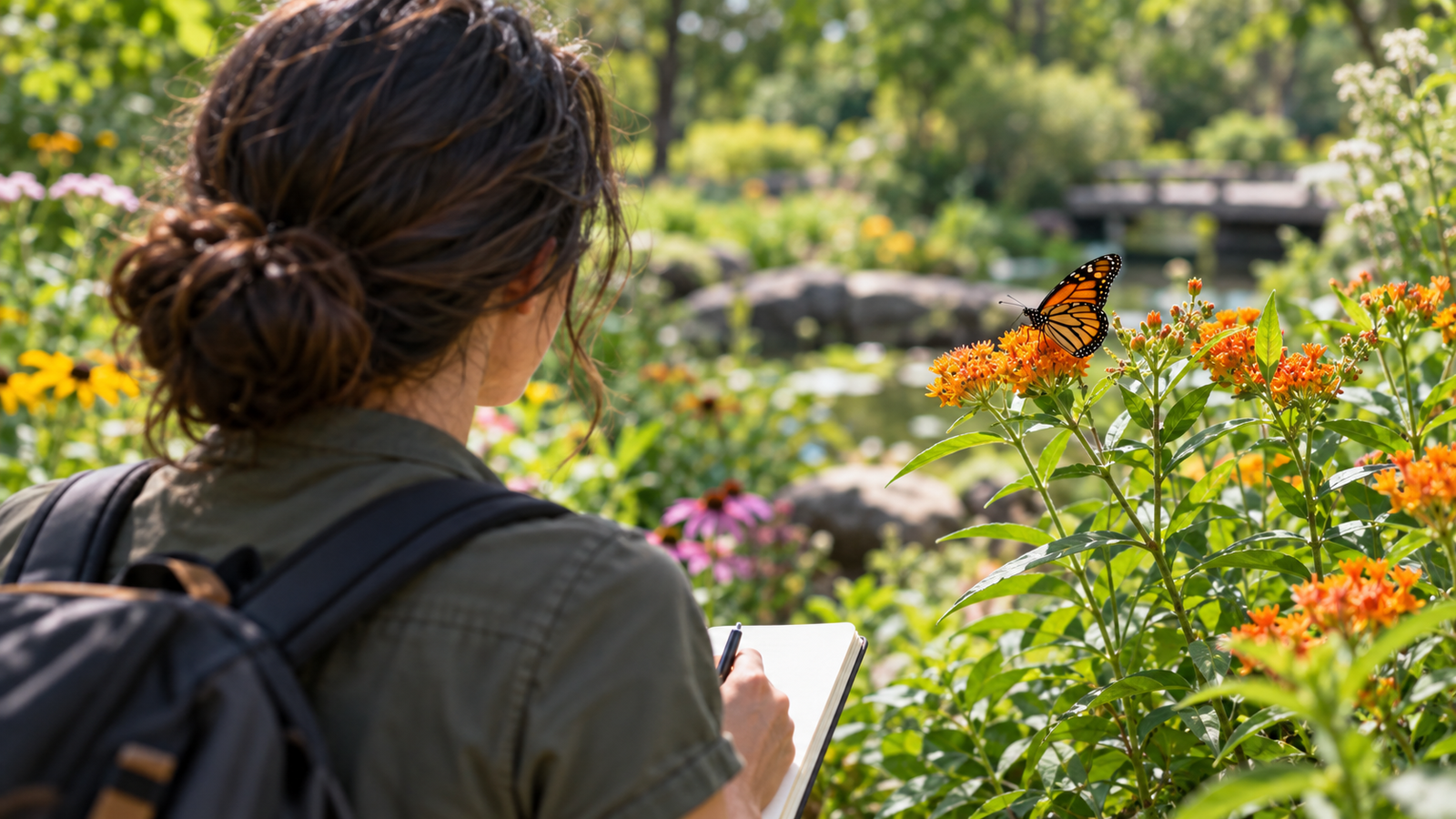
Generated imagery must never be submitted as an actual nature observation. An editorial illustration can explain a concept in an article, but it is not evidence that an organism was present at a location. The same applies to stock photographs or images borrowed from another observer. Use only your permitted observation evidence, with appropriate consent and rights. This boundary protects the scientific record and the people contributing to it without requiring every participant to own professional camera equipment.
Respect wildlife, people and sensitive places
Observation should not require disturbing an animal, damaging habitat, entering restricted land or exposing someone else’s private information. Follow local rules and the project’s safety instructions. If the project has policies for sensitive species or locations, use them. A public map can reveal more than a contributor intends, so check what location details will be displayed before submitting. The right amount of public precision may differ from the information a project securely collects for research.
For a family activity, decide in advance who will handle the device and what information may be shared. Avoid including identifying details about children in public notes or photographs. Do not approach wildlife to improve a picture, handle unknown organisms or collect samples unless the project explicitly authorizes the activity and you can follow all applicable guidance. A useful observation does not need to be the closest photograph or the most dramatic encounter.
Separate absence from nondetection
Not seeing an organism during a visit does not automatically establish that it was absent from the area. Detection depends on where, when and how you looked, as well as the organism’s behavior and visibility. A project may have a defined way to record nondetections, but you should not invent one. Read whether the project seeks complete checklists, selected sightings or another record type. Those distinctions affect what later users can infer from the submitted data.
As an original example, a quiet pond during a short afternoon visit does not prove that no amphibians use it. It describes what was detected under that visit’s conditions. Recording the time, effort and relevant observations makes the result more interpretable. A later visit may differ for several reasons. Avoid turning an appealing personal story about a place into a claim about population decline or recovery without suitable longer-term evidence and analysis.
Review the record before submitting
Check the date, location, count and identification against your notes. Make sure photographs belong to the observation and that any required effort fields are accurate. If you discover an error later, use the project’s correction process. A correction is a useful contribution to data quality, not something to hide because a record has already received attention. Preserve uncertainty where it remains, and avoid adding details merely because the submission form has an empty field.
Our suggested final check asks: could another person tell what I observed and what I am unsure about? If the answer is no, improve the note or reduce the certainty of the claim. This is especially helpful when an identification suggestion feels persuasive. A clear record of a modest observation can have more scientific value than a confident species name attached to evidence that does not support it.
Let participation build skill over time
You do not need to know every species before joining an appropriate beginner-friendly project. Choose one whose requirements fit your location, abilities and available time. Read the current instructions and learn from feedback. Keep a personal record of the features or methods you want to understand better. The aim is to improve observation and contribute within a defined method, not to compete for the highest total or the most unusual sighting.
Cornell’s participatory-science work illustrates how many people’s contributions can support larger scientific questions. That possibility depends on transparent methods and careful records, not just enthusiasm. Start with an actual project, follow its protocol, preserve uncertainty and respect the setting. Those habits turn curiosity into a contribution that others can interpret, while keeping the experience accessible enough to repeat and enjoyable enough to sustain.