Why Holiday Cacti Bloom: The Science of Long Nights and Growing Conditions
Key Points:
- Holiday cacti respond to growing conditions, not the date printed on a calendar.
- For Thanksgiving and Christmas cacti, long nights and suitable temperatures help initiate flower buds.
- Starting a bud and developing it into an open flower are different stages, so one simple rule cannot describe the whole process.
- Severely drying a plant is not a reliable flowering shortcut; experiments found fewer buds under high water stress.
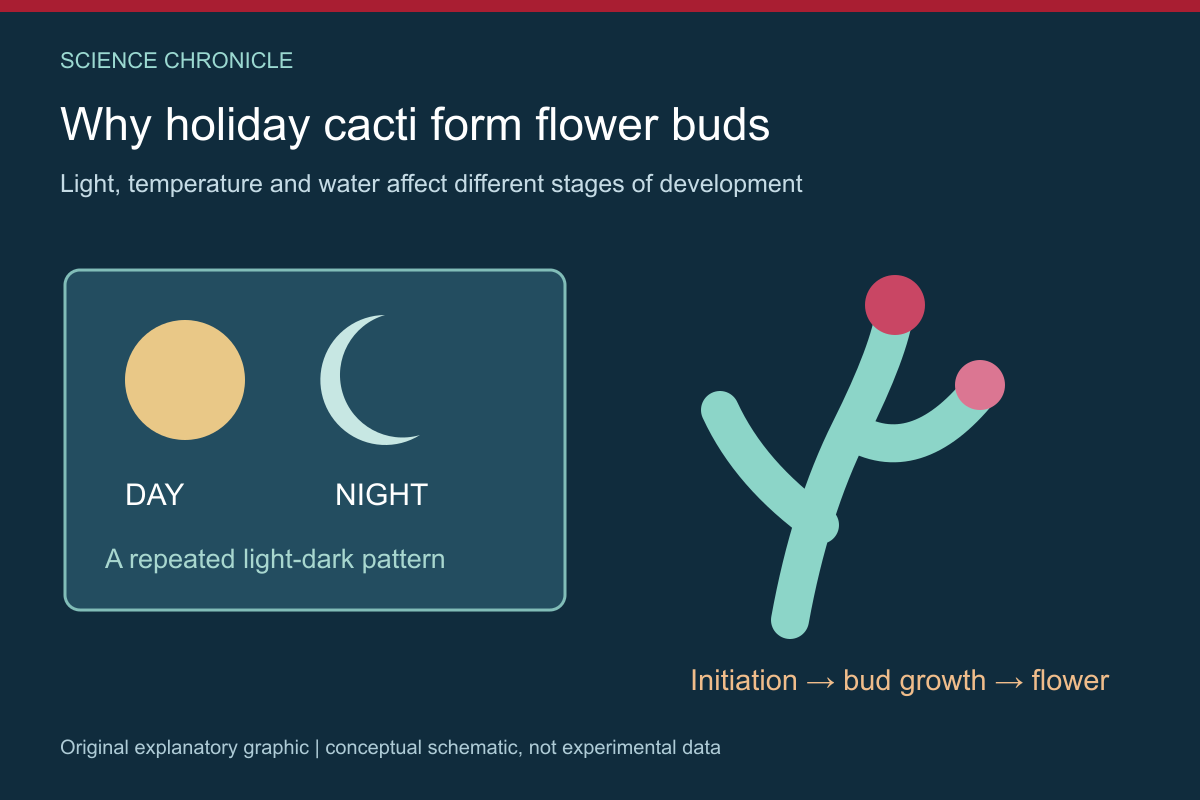
A holiday cactus can sit quietly for months and then produce a row of buds near the ends of its stems. How does it know when to flower? It does not recognize Thanksgiving or Christmas. Its development responds to environmental conditions, including the pattern of light and darkness and the temperature around it.
Start by identifying the plant
Iowa State University’s guide to holiday cacti distinguishes Thanksgiving, Christmas and Easter cacti, plants often grouped together in shops and homes. Their common names are useful clues, but not precise flowering appointments. Different kinds and varieties can respond differently.
These are also not interchangeable with the familiar image of a desert cactus. Their flattened green segments are stems, and their growing habits reflect a different environment. Before changing care, it is worth checking which plant you have rather than applying every piece of advice attached to the word cactus.
The length of the night is part of the signal
University of Minnesota Extension explains how short days and cool conditions affect flowering. In a home, artificial light at night can alter the pattern the plant experiences. A room that looks seasonally dim to us during the day may still offer a short night if lamps stay on late.
The point is not that darkness supplies food. The plant still needs suitable daytime light. Daytime light and an uninterrupted night answer different biological needs. This is why keeping a plant in continuous darkness is not the same as providing an appropriate day-night pattern.
Making a bud is different from opening a flower
Original research modeling flower-bud growth in Schlumbergera truncata tracked development across controlled temperatures. The researchers built a model using one set of observations and checked it against separate experiments involving temperature changes. Their results show why the progress of a developing bud cannot be reduced to a fixed number of days that applies in every home.
A useful analogy is starting a journey versus the speed of travel after departure. The conditions that help initiate a bud are not the entire explanation for how quickly it later opens. The analogy describes the question, not the actual biology. Horticultural experiments distinguish these stages so that a result about one is not mistakenly applied to the other.
Why “stress it into flowering” is too simple
In an experiment by Royal Heins, Allan Armitage and W. H. Carlson, Thanksgiving cacti undergoing flower initiation produced fewer buds under high water stress. The study compared specified watering and temperature conditions under short days. It does not support the broad claim that severely dehydrating a holiday cactus is a dependable way to obtain more flowers.
That finding is different from saying that potting mix should always remain wet. Iowa State’s guidance emphasizes drainage and avoiding waterlogged conditions. The useful distinction is between allowing appropriate drying and subjecting a plant to a prolonged drought. A catchy instruction to neglect the plant hides that difference.
| Observation | Question to record |
|---|---|
| No buds yet | Which kind of holiday cactus is it, and what light-dark pattern does it receive? |
| Buds are developing slowly | Has the temperature changed since buds appeared? |
| Plant looks stressed | Is the mix waterlogged, excessively dry or draining poorly? |
| Flowering differs from last year | Which conditions changed, rather than which calendar date was missed? |
Observe before changing everything
A simple notebook can make the question more interesting. Record where the plant sits, when nearby lights are turned off, the approximate room temperature and when buds first appear. A photograph taken from the same position can help track development without handling the plant repeatedly.
These are observation suggestions, not a guarantee of blooms. Changing location, watering, temperature and feeding together makes it difficult to know which change mattered. A healthy plant and a better understanding of its conditions are more useful goals than forcing it to meet a holiday deadline.
The satisfying explanation is that a familiar houseplant can reveal how living things respond to patterns in their surroundings. Its flowers are the outcome of development under particular conditions, not proof that it has read our calendar.
Older archive topic independently rewritten and substantially revised October 25, 2026.
Sources and further reading
- Heins, Armitage and Carlson. Influence of Temperature, Water Stress and BA on Vegetative and Reproductive Growth of Schlumbergera truncata. HortScience. Original experiment.
- Modelling temperature and flower bud growth in November cactus. Scientia Horticulturae. Original experiments and model validation.
- University of Minnesota Extension. Holiday cacti. Original university guidance.
- Iowa State University Extension and Outreach. All About Holiday Cacti. Original university guidance.